There's been a lot of talk this past week about training ratios after SDI — Scuba Diving International — lowered theirs. First, credit where it's due: good on them for making a move. But I'll be honest — it's not enough.
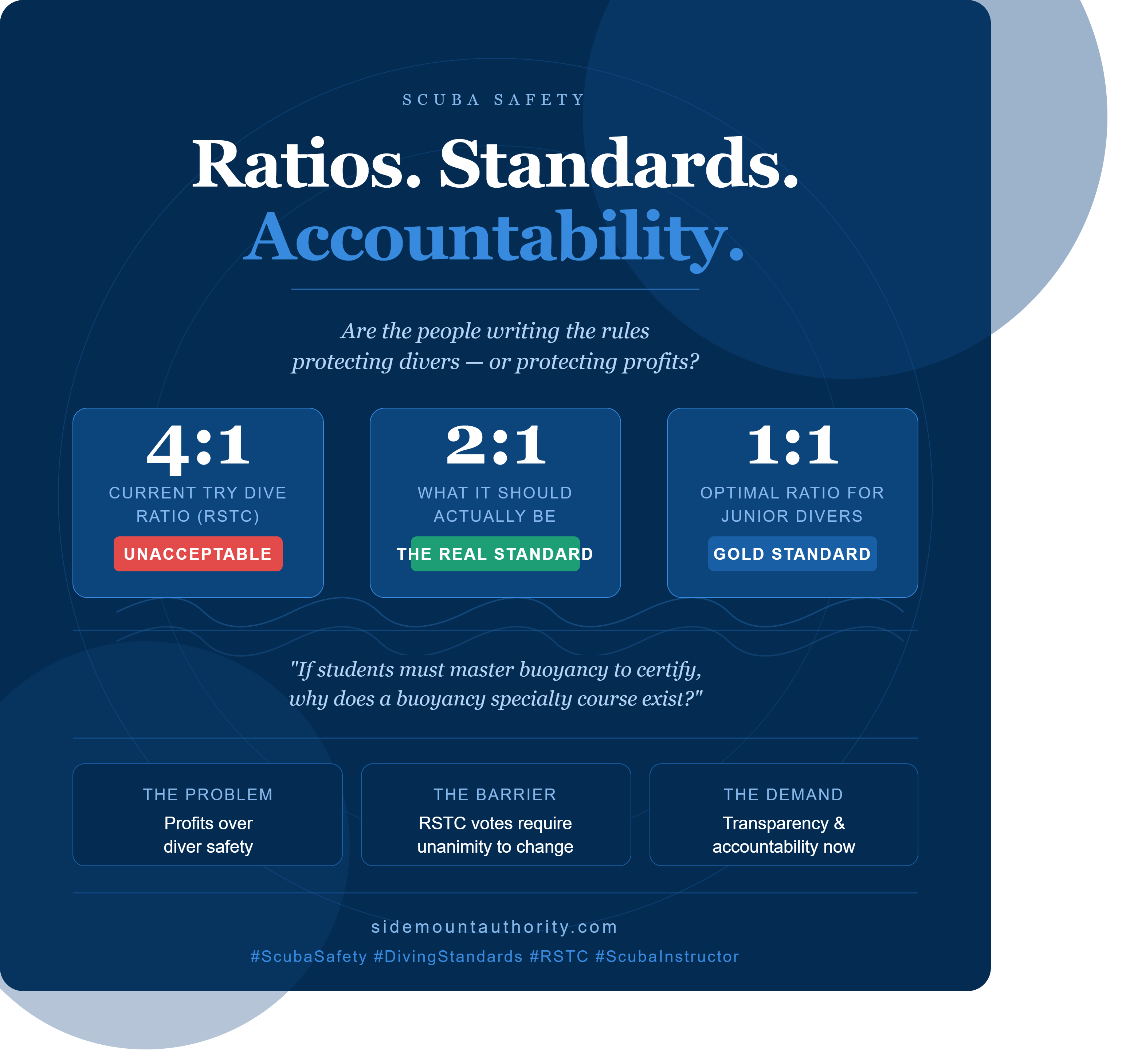
When it comes to junior divers, I believe the maximum ratio should be 2:1, with 1:1 being the gold standard. Period.
But here's the ratio nobody touched — the one most instructors actually complain about — the Try Dive, or Discover Scuba Dive. The RSTC currently sets that at 4:1. It always has been, and it has always been absurd. I have two hands. Most of you do too. Unless some of you are hiding a prehensile tail — in which case, I'm genuinely jealous — that ratio should be 2:1. This has been challenged at the RSTC level more times than I can count. But two agencies keep blocking it, and since any change requires a unanimous vote, we're still stuck at 4:1. A ratio that, in my professional opinion, puts both students and instructors at unnecessary risk.
Now let's talk about "minimum standards" — because the phrase itself tells you everything.
By definition, minimum standards are mandatory baseline requirements established to ensure safety, legality, or basic functionality. They are the floor. Not the ceiling. Not the goal. The floor.
I've taught above minimum standards for years, and so have most of the instructors I respect. If you visit the "Instructors" section of this site you'll find a list of sidemount instructors who do the same. Notice something about that list? Most of them own their own dive centers or work independently. That's not a coincidence.
Here's the uncomfortable truth: instructors employed by dive centers are regularly pressured to cut corners. The message, spoken or unspoken, is do it our way or we'll find someone who will. And there's always someone willing. Dive center owners — and frankly, most of the agencies — are running a business. The faster you complete an Open Water course, the faster you can start another one, and the more money flows in. Maxed-out ratios mean students spend more time sitting on the boat waiting to practice skills than actually developing them. That's not training. That's processing.
And it doesn't stop there. Some operators are pushing instructors to run 5 or 6 dives a day. Yes, the standard limits students to 3 training dives a day — but that limit doesn't apply to the instructor. There is no ceiling on how hard you can work a professional into the ground, apparently.
So let me ask this plainly: with a 4:1 Try Dive ratio, no cap on instructor dive limits, and an Open Water standard that says students must master skills like neutral buoyancy before they certify — why does a buoyancy specialty course exist? If the standard means what it says, that skill should already be mastered. If students are leaving courses without it, the standard isn't being met. And if nobody's checking, then the standard is meaningless.
If we actually want to improve this industry, we have to look at how the RSTC operates. The problem is, we can't. Those meetings are protected by NDAs. The organization responsible for setting the safety standards that govern every one of us operates in complete secrecy.
I think that needs to change.
Instructors are required to follow RSTC standards. We should have access to the meeting minutes. We should be able to hold that organization accountable. There have to be checks and balances — because right now, I have no way of knowing whether the people writing the rules that are supposed to keep me and my students safe actually care about safety, or whether they're just protecting their own financial interests.
I'd like to find out.