Crossing Over: What Backmount Divers Get Wrong First
Every crossover diver walks into their first sidemount session the same way: confident. They've got hundreds of dives, a wall of cards, maybe a tech certification or two. They assume sidemount is a gear swap; same diving, more cylinders and a different BCD. It's not. And the divers who struggle hardest aren't the new open water students. They're the experienced backmount divers who think their experience transfers automatically. It doesn't, not without unlearning a few habits first. Here's what I see, every single crossover course, before we even get to the fun stuff.
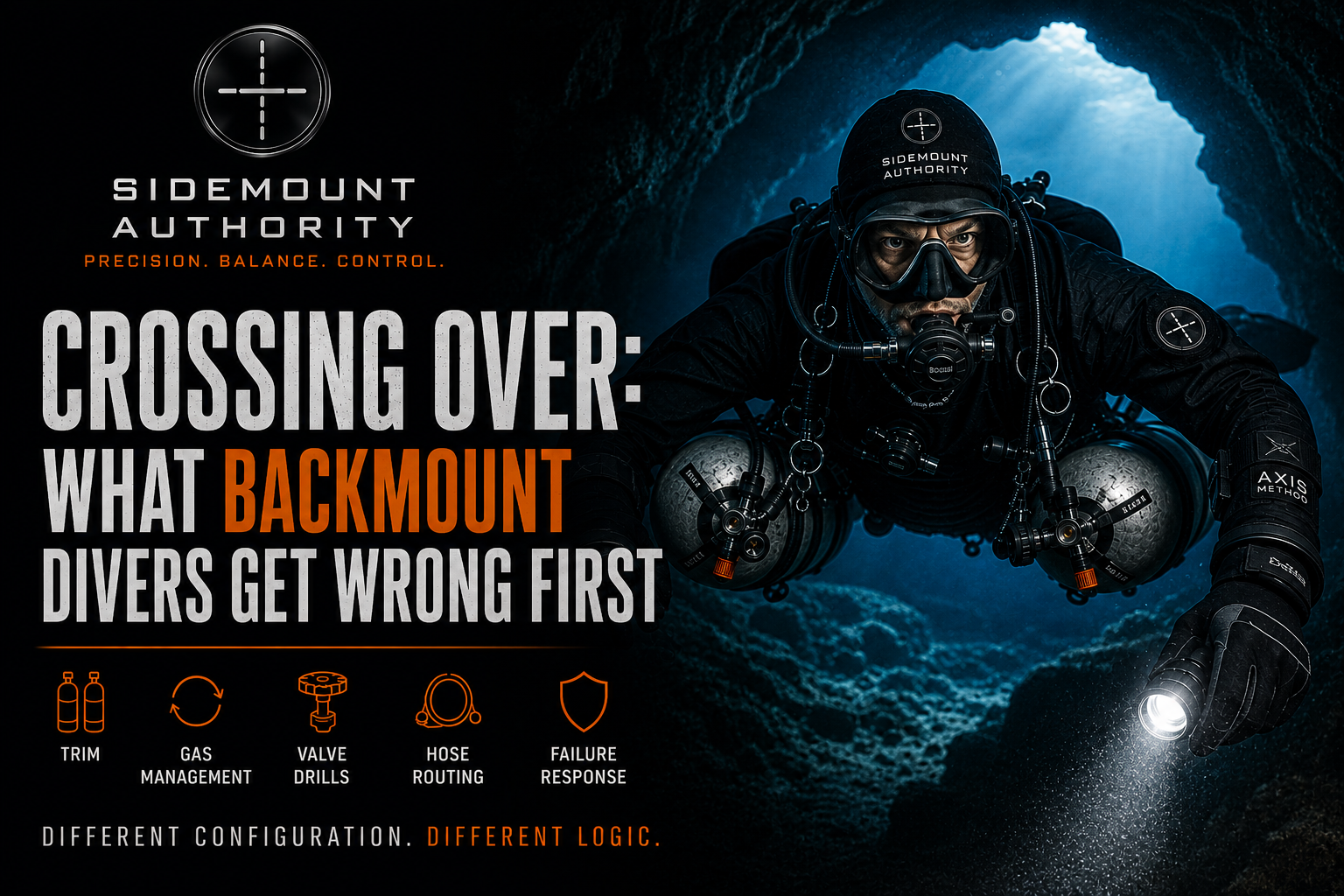
Mistake One: Trying to Trim Like a Backmount Diver
In backmount, your trim is built around a single point of buoyancy on your back and a wing that does most of the work for you. You can be lazy about body position and the rig mostly forgives you. Sidemount doesn't forgive, it exposes. You've now got two independent, asymmetrical buoyancy sources hanging off your sides, and your body has to actively manage the balance between them. New sidemount divers consistently try to muscle their way into a flat trim using the same core engagement and kick style they've used for years and end up rolling, finning up silt, or fighting the rig the entire dive. The fix isn't more effort. It's less. Sidemount trim comes from passive alignment; cylinder placement, harness fitting, and weighting doing the work, not your body fighting to compensate for a system that isn't aligned correctly yet.
Mistake Two: Treating Gas Switches Like an Afterthought
Backmount divers are used to breathing off one regulator for the entire dive, with a long hose as a donation backup. Gas switching is something that happens on deco, on stage bottles, occasionally. In sidemount, switching regulators is baseline behavior. You're managing gas from two cylinders constantly, not just at planned intervals. Crossover divers routinely under-practice this. They know how to do it, technically, but they haven't built the muscle memory to do it without thinking, without breaking trim, without looking at their SPGs to see if they should switch and without losing situational awareness for those two or three seconds. This is one of the first things we drill relentlessly in sidemount training, because it's the skill most likely to expose task-loading under stress later.
Mistake Three: Underestimating the Valve Drill
Ask a twinset diver to do a valve shutdown and they'll reach behind their head, find one manifold, and go. It's a known motion, rehearsed a hundred times. Sidemount has two independent valves, positioned differently, requiring different body mechanics to reach and no manifold to fall back on. Twinset divers often assume this is a minor variation on a skill they already have. It isn't. It's a new skill wearing an old skill's name. I've watched highly experienced divers fumble a sidemount shutdown that they'd have nailed instantly in backmount, simply because the reach, the angle, and the reference points are all different.
Mistake Four: Ignoring Hose Routing Discipline
In backmount, hose routing is mostly fixed by the rig, there's a right way to set it up and you do it once. Sidemount hose routing is dynamic. It can change based on cylinder size, water temperature (wetsuit vs. drysuit bulk), and your specific body geometry. Crossover divers frequently try to copy a routing setup they saw online or borrowed from a buddy without understanding why that routing worked for that diver's configuration. Then they wonder why their hoses snag, dangle, or create drag. Good hose routing isn't aesthetic. It's function first and it has to be rebuilt for sidemount from first principles, not carried over.
Mistake Five: Assuming Equipment Failure Response Is the Same
This is the one that actually matters most. In twinset diving, most failure response training is built around a single point of failure; the manifold and a long-hose donation. Sidemount changes the entire logic of gas redundancy. You have two fully independent gas sources from the start. That's a strength, but only if you've actually internalized how to isolate a problem cylinder, switch to the working one, and manage the dive plan around asymmetric gas consumption in real time. Crossover divers who haven't unlearned the "single system, single failure" mindset from backmount tend to freeze or hesitate exactly when sidemount's redundancy should be making the emergency easier to handle, not harder.
The Real Issue
None of this is about twinset divers being bad divers. It's the opposite — they're good enough that their instincts are strong, which makes those instincts harder to override when they're the wrong instincts for this configuration. Sidemount isn't backmount with the cylinders moved. It's a different logic system for buoyancy, gas management, and redundancy, and it demands you actually understand why it works the way it does — not just that it works. That's the whole premise behind how I run sidemount training. We don't polish old habits. We rebuild the ones that don't belong, and keep the ones that do and it is all done in a properly aligned system.