How to Choose a Good Sidemount Instructor (And the Questions That Actually Reveal One)
Choosing a sidemount instructor is a little different from choosing most scuba instructors.
You aren't just paying someone to show you how to put cylinders on your sides. You're trusting that person to help you build a system you may eventually rely on in an environment where getting something wrong can have serious consequences.
And yet, most divers choose an instructor in pretty much the same way they choose everything else online.
They search for someone nearby. They look at reviews. They see who has an opening next weekend. They check which agency the instructor teaches for and, if everything looks reasonable, they book the course.
I understand why people do it that way.
The problem is that none of those things necessarily tell you whether the person standing in front of you is actually a good sidemount instructor.
Two instructors can hold the same rating, teach under the same agency, and have the same number of students on paper — and produce very different divers.
One may teach you how to understand the system.
The other may teach you how to get through the course.
Those aren't the same thing.
So before you book a sidemount course, here are some questions I'd ask.
Start With Their Own Experience
Don't start by asking how many students they've certified.
Start by asking how they got into sidemount themselves.
Ask:
- How long have you personally been diving sidemount?
- How long were you diving it before you started teaching it?
- What were you diving before sidemount?
- Why did you switch?
- Do you still regularly dive sidemount when you're not teaching?
That last question is particularly interesting.
There's nothing inherently wrong with an instructor teaching a configuration they don't use on every personal dive. But there is a difference between someone who genuinely understands sidemount as a diving configuration and someone who mainly puts the equipment on when a student shows up.
I'd want to know that my instructor has spent enough time in the configuration to have experienced the problems I'm likely to experience.
Cylinder buoyancy changes.
Conditions change.
Loss of gas events.
The dive doesn't always go according to the plan you made on the surface.
An instructor who has spent years actually diving the configuration has had to solve problems that don't show up on a skills checklist.
That's valuable experience.
Find Out How They Became an Instructor
This is one of the questions I think more divers should ask.
Not because one particular certification pathway automatically makes someone a better instructor, but because you should understand how the person teaching you was evaluated.
Ask:
"How was your sidemount instructor rating obtained? Were you directly evaluated by an Instructor Trainer or Course Director?"
Then ask who evaluated them.
Different agencies have different instructor-development and application processes, so don't assume that a particular pathway automatically means someone is good or bad. What you're trying to understand is whether someone actually had their teaching ability evaluated or whether they simply met the prerequisites for an application pathway.
And pay attention to how they answer.
A good instructor shouldn't be offended by the question.
They should be able to explain where they trained, who evaluated them, what their instructor development looked like, and what they had to demonstrate before they were allowed to teach.
If they become defensive because you asked how they were evaluated, I'd consider that useful information.
You're not challenging their ego.
You're trying to decide who you're going to trust with your training.
Don't Ask If They Teach Good Trim. Ask How They Teach It.
Every sidemount instructor will tell you that trim matters.
That's not really useful information.
Instead, ask:
"If my trim is bad, how do you figure out what's causing it?"
That's a much better question.
Listen to the answer.
Are they talking about cylinder placement? Harness configuration? Weight distribution? Body position? Buoyancy? Tank position relative to the diver?
Or is the answer basically:
"We'll work on your body position until you get it."
There is a place for learning body position. But trim isn't simply something you force your body into.
A diver can look perfectly horizontal for a few seconds and still have a poorly balanced system.
Good sidemount instruction should teach you how to identify why you're out of balance, not simply what position you should try to hold.
That's an important distinction.
If the instructor can diagnose the problem, they can help you solve it.
If they can only demonstrate the finished position, you may find yourself struggling the next time something changes.
Ask What Failure Training Actually Looks Like
Sidemount is often sold on redundancy.
Two cylinders. Two regulators. Independent gas supplies.
That's a legitimate advantage.
But redundancy doesn't automatically make a diver competent.
You have to know what to do with that redundancy when something goes wrong.
So ask:
- How much failure-drill practice is included in the course?
- How often will I actually practice switching between gas sources?
- Will I practice failures outside of a controlled pool environment?
- What happens if I still struggle with a valve shutdown or regulator switch near the end of the course?
That last question is one of my favorites.
A good instructor should have an answer.
Not every student learns at the same speed. Some divers pick up the configuration quickly. Others need more time. Some have excellent buoyancy but struggle with valve access. Others are comfortable with the equipment but fall apart when several tasks have to happen at once.
That's normal.
What matters is what the instructor does about it.
I'd rather have an instructor tell me, "You're not ready yet, so we're going to spend another session working on this," than someone who says, "You've completed all the skills, so here's your card."
Certification and competence are not always the same thing.
If You're Coming From Twinset, Ask About Crossover Training
Crossover divers have a particular problem.
They already know how to dive a redundant configuration.
That's an advantage.
It can also be a disadvantage.
You bring habits with you.
Some of those habits are useful. Some aren't.
And some things that work perfectly well in a twinset simply don't translate cleanly into sidemount.
So if you're a crossover diver, ask:
"What do you see twinset divers doing wrong when they first move into sidemount?"
Then ask:
"How do you address those habits during the course?"
I'm less interested in hearing that the crossover course is "shorter" or "faster" than the standard course.
I'd rather hear what actually changes in the instruction.
A good crossover instructor understands that you're not starting from zero. But they also understand that previous experience doesn't automatically make you good at sidemount.
Sometimes the hardest part of crossover training isn't learning something new.
It's getting rid of something you've already learned.
Ask to Speak With Former Students
This one makes some instructors uncomfortable.
It shouldn't.
Ask if they can put you in contact with one or two recent sidemount students.
Then don't ask those students whether they "liked the instructor."
Ask better questions.
For example:
What was the hardest part of the course?
Did the instructor explain why things were being changed, or mostly tell you what to change?
Did you feel prepared to go diving on your own afterward?
What happened when you struggled with something?
Those answers will tell you considerably more than a five-star review.
A student who says, "The instructor was awesome and I had a great time" doesn't tell you much.
A student who can explain what they struggled with, how the instructor diagnosed it, and what changed as a result gives you something useful.
And don't expect every former student to say the course was easy.
Actually, I'd be a little suspicious if everyone says it was.
Good training isn't necessarily comfortable.
Pay Attention to How They Talk About Students Who Struggle
This is probably one of the biggest things I would look for.
Listen to an instructor talk about difficult students.
Do they blame the student?
"Some people just can't get their trim."
"Some people don't have the right body type for sidemount."
"They just weren't coordinated."
Or do they talk about the problem as something that has to be diagnosed?
There's a big difference.
Teaching isn't demonstrating something correctly and then waiting for the student to copy you.
If a student can't reproduce the result, the instructor needs to figure out why.
Maybe the equipment isn't configured correctly.
Maybe the student doesn't understand the task.
Maybe the explanation isn't working.
Maybe the skill needs to be broken down differently.
Maybe the student needs a completely different approach.
That ability to diagnose a problem is one of the things I value most in an instructor.
Look at the Instructor's Diving, Too
This one is simple.
Watch them dive.
Not for Instagram.
Not during a staged photograph.
Watch them actually work underwater.
Look at their trim.
Look at their propulsion.
Look at what their cylinders are doing.
Watch how they handle a task.
Watch whether they're constantly making little corrections or whether the configuration appears to stay where it belongs without a lot of effort.
I'm not saying an instructor has to look like a perfectly motionless underwater statue on every dive.
Nobody does.
But the way an instructor dives tells you quite a bit about what they consider normal.
And that's worth paying attention to.
Don't Confuse a Great Diver With a Great Instructor
This deserves its own section because it's an easy mistake to make.
Someone can be an excellent sidemount diver and a mediocre instructor.
Being able to do something doesn't automatically mean you can teach someone else how to do it.
The best instructors can explain what they're seeing.
They can break complicated problems into manageable pieces.
They can recognize when the problem isn't what it initially appears to be.
And, importantly, they can change their teaching approach when the first explanation doesn't work.
That's teaching.
A diver who simply says, "Watch me and do this," may be an impressive diver.
That doesn't necessarily make them a good instructor.
What Should a Good Instructor's Answers Sound Like?
I'm not looking for someone who has memorized the perfect answers to all of these questions.
In fact, I'd probably be more suspicious of that.
I'm looking for specifics.
Real examples.
An instructor who says:
"I had a student last year who kept dropping his right cylinder. We eventually discovered that the problem wasn't his body position at all. His attachment point was wrong for the harness configuration he was using."
That's useful.
Compare that with:
"Everyone is different. We adjust the equipment to the student."
The second answer sounds good.
It just doesn't tell you anything.
Good instructors can usually talk about real students, real problems, and real solutions without turning the conversation into a sales pitch.
They don't need to convince you that they're great.
They can explain how they teach.
The Questions I'd Actually Ask
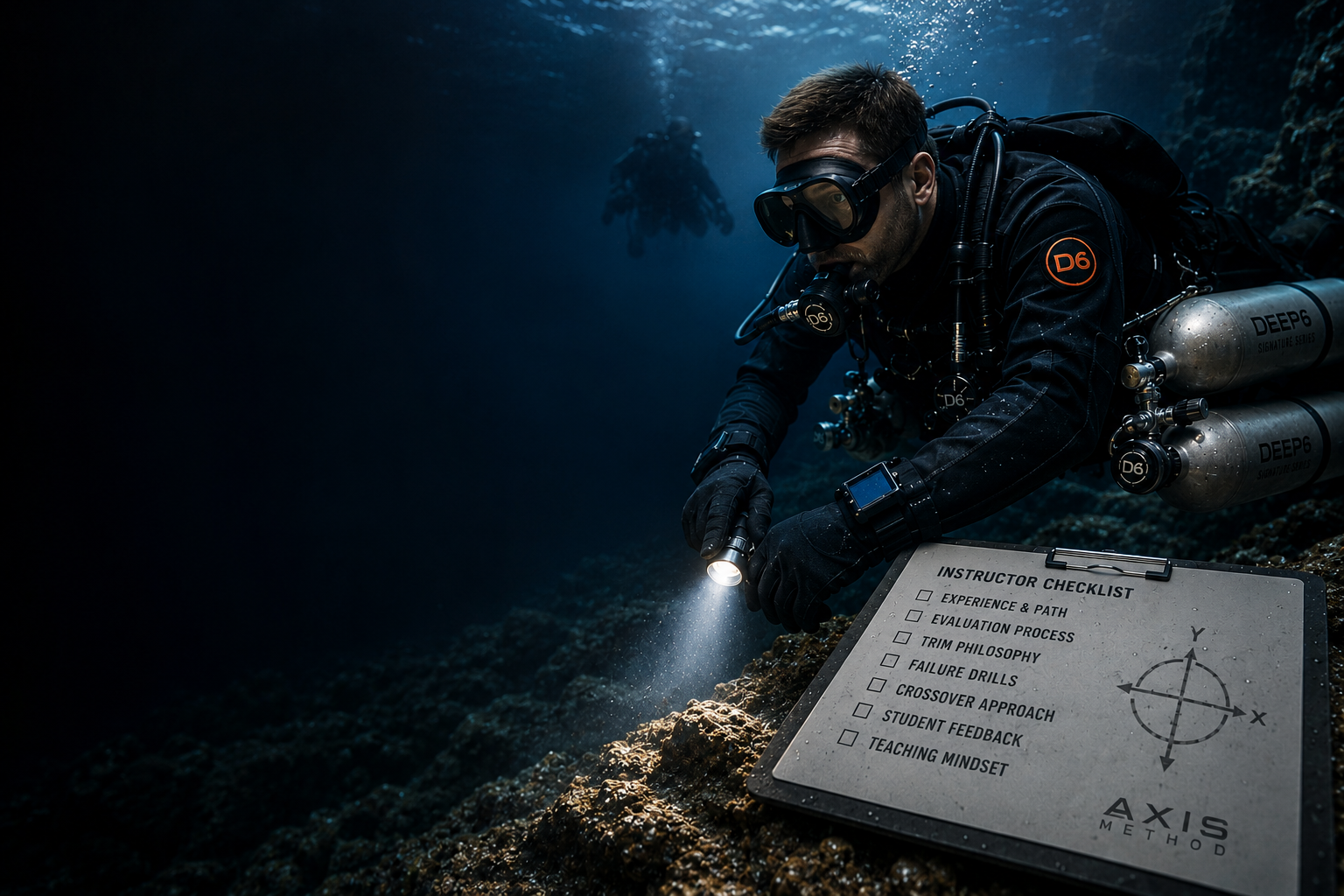
If I were choosing an instructor for myself, these are the questions I'd have ready:
- How long have you personally been diving sidemount?
- How long were you diving it before you started teaching it?
- How were you evaluated before receiving your instructor rating?
- How do you diagnose a student's trim problem?
- How much failure-drill practice is included in the course?
- What do you do when a student isn't ready by the final dive?
- How does your crossover training differ from your standard sidemount course?
- Can I speak with one or two recent students?
- What are the most common problems you see in your sidemount students?
- Can I watch you teach or dive before I commit to the course?
You don't have to interrogate an instructor with all ten.
Pick the ones that matter most to you.
The point isn't to catch an instructor in a gotcha question.
The point is to find out how they think.
Why I Put This List Together
I've spent a lot of time working with divers who already had sidemount certifications.
On paper, they looked fine.
They had the certification.
They had the required dives.
They had bought the equipment.
But once we started working together, there were gaps.
Sometimes it was trim.
Sometimes it was equipment configuration.
Sometimes it was gas management.
Sometimes it was a failure response that technically existed on their skills checklist but wasn't something they could perform confidently under pressure.
And that's when I started paying more attention to the difference between being certified and being competent.
A certification tells you that someone completed a course.
It doesn't tell you everything about the quality of the instruction they received.
That's why I think divers should ask more questions before choosing an instructor.
Not because every instructor with a different teaching philosophy is bad.
Not because one agency or one certification pathway automatically produces better instructors.
And certainly not because I think I'm the only person who can teach sidemount correctly.
Quite the opposite.
There are some very good sidemount instructors out there.
The challenge is figuring out who they are.
So ask questions.
Pay attention to the answers.
Talk to their former students.
Watch them teach.
And look for an instructor who is interested in helping you understand why your system works, not simply showing you what it is supposed to look like.
That's the instructor I'd want.
And that's the standard I think divers should expect.
Looking for an Instructor?
If, for whatever reason, you don't want to train with me, that's completely fine.
I've put together a curated list of sidemount instructors I genuinely believe are worth considering.
It's intentionally a short list.
It will change over time as I meet instructors, dive with them, see how they teach, and decide whether I'd be comfortable sending one of my own students to them.
Because that's ultimately the standard I use:
Would I trust this instructor with someone I care about?
If the answer is yes, they're worth recommending.
If it isn't, they won't be on the list.