
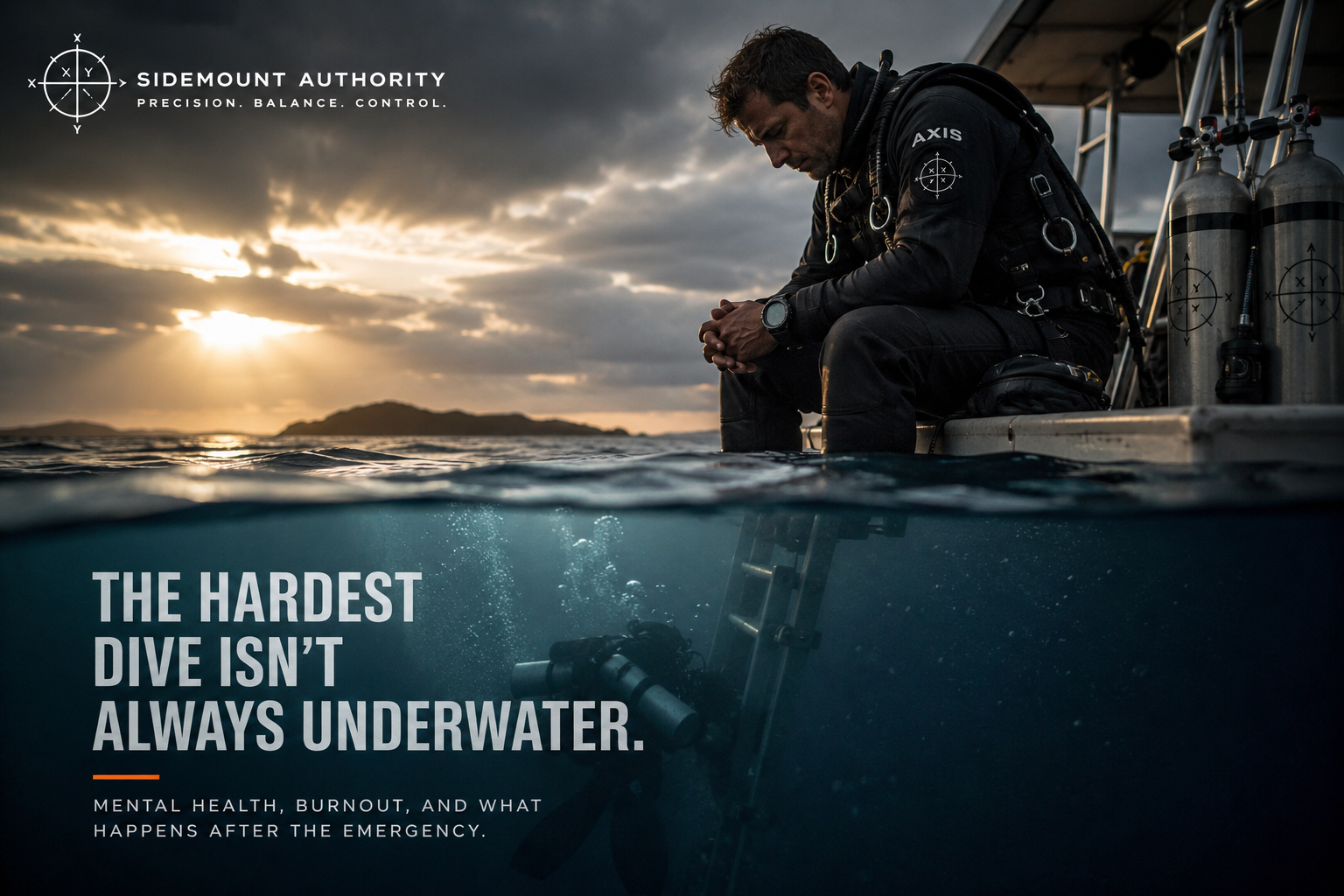
What Nobody Tells You About Being an Instructor: Burnout, Trauma, and What Happens After the Emergency
Every instructor course spends hours on rescue skills — unconscious diver response, CPR, oxygen administration, coordinating an evacuation. What almost none of them spend any time on is what happens to the instructor after the rescue is over. I've been teaching and mentoring divers and instructors long enough to know that gap isn't hypothetical. It's one of the least talked-about problems in this industry, and it affects instructor performance in ways that eventually reach students too.
The Job Is Heavier Than It Looks From the Shore
From the outside, teaching diving looks like one of the better jobs available: you're paid to be in the water, introducing people to something that can genuinely change how they see the world. That part is real. It's also only half the picture.
A working instructor isn't just demonstrating skills. They're tracking gas, trim, buoyancy, and body language on every student in the water simultaneously, while also managing gear logistics, boat schedules, weather calls, and the accumulated fatigue of back-to-back days that rarely include a real break. Full-time instructors, especially at high-volume operations, can run three or four dives a day, six days a week, for months at a stretch — and still be expected to show up mentally sharp for the diver whose trim just went sideways at 18 meters. That's not a complaint about the job. It's a fact about the job that almost never makes it into how the profession gets discussed publicly.
Watching Everyone Else's Risk Is a Different Job Than Managing Your Own
Recreational diving asks you to manage your own risk. Instructing asks you to manage everyone else's, simultaneously, while still managing your own. That's a categorically different mental load, and it doesn't turn off between certifications.
Good instructors run a constant background process: who's breathing too fast, whose trim just changed, who's getting task-loaded, who hasn't checked their pressure gauge recently, what the current is doing to the group. That vigilance is exactly what prevents small problems from becoming emergencies — it's not optional, and it's part of what you're actually being paid for. But sustaining that level of attention for years, dive after dive, carries a cost that rarely gets acknowledged, let alone addressed.
Rescue Training Prepares You for the Emergency, Not for What Comes After
Instructors are trained extensively to respond in the moment. When something actually happens, most instructors do exactly what they were trained to do — they switch into procedure, the adrenaline carries them through, and they function. That part of the system generally works.
What the training doesn't cover is what happens once the emergency is over. The boat returns, the gear gets rinsed, the incident report gets filed, and everyone goes home; except the instructor may not actually be finished processing what happened. If you've ever performed CPR on a student, provided rescue breaths, or pulled someone from the water while doing everything right and still lost them, there's no course module that prepares you for what that does to you afterward. That's not a hypothetical scenario in this industry. It happens, and when it does, the instructor involved is often left to work out the aftermath entirely on their own.
The Reactions That Follow Aren't a Sign of Weakness
Difficulty sleeping. Replaying the incident. Second-guessing a decision that was actually correct. Hypervigilance underwater. Losing confidence in a skill you've performed a hundred times. Feeling numb around the exact site, boat, or piece of gear involved. These are ordinary human responses to an extraordinary event, not evidence that someone is unfit to teach. There's no fixed timeline for processing something like this; some instructors are functioning normally within days, others don't feel the full weight of it until months later, and both are completely normal.
The bigger problem is structural: many instructors are independent contractors or work for small operations where taking real time off after a serious incident isn't treated as an option. The shop still has bookings. Someone still has to dive with the guests. So instructors go back to teaching days after something traumatic happened, standing in the same gear-up spot, saying the same "let's get set up" they always say — while carrying something nobody else on the boat knows about.
Burnout Doesn't Need a Single Incident to Take Hold
Not every version of this comes from one catastrophic event. More often it's cumulative: too many consecutive teaching days, picking up an extra course because the shop is short-staffed, spending the one free evening servicing gear and answering student messages instead of resting, then doing it again the next morning. Eventually the dives that used to be the reason you got into this stop feeling like anything except another item on the schedule. That's not a sign you picked the wrong career. It's a sign you've been running on empty for longer than anyone noticed, including you.
The "Tough Instructor" Culture Makes This Worse
There's a real culture in diving, and in tech and cave diving in particular, that rewards not showing strain. You stay calm, you don't complain, you don't let students see that a dive shook you. Staying composed in front of students during an actual emergency is legitimately part of the job. Pretending you're unaffected by it afterward is not the same thing, and treating them as the same thing is exactly what keeps instructors from getting support before a slow burnout turns into someone leaving the industry entirely, or worse, staying in it while running on fumes.
Experience doesn't make anyone immune to this. If anything, instructors who've been doing this longer tend to understand more clearly what could have gone wrong, which can make a bad incident hit harder, not easier.
Instructor Wellbeing Isn't Separate From Diver Safety
This is the part the industry treats as a side issue, and it shouldn't be. An exhausted or unprocessed-trauma-carrying instructor has less attention, less patience, and less capacity to catch the early signs of a developing problem underwater; the exact vigilance that's supposed to be their core job function. Every hour spent as an industry refining gas planning, ratios, and emergency procedures is an hour that could just as easily go toward building actual post-incident support for the people executing those procedures: a real debrief process after a serious incident, not just an incident report; a workload culture that doesn't quietly expect instructors to be back in the water the next morning; and a norm where an instructor saying "I need a minute with this one" is treated as professional judgment, not as a liability.
Where This Leaves You, If You're an Instructor Reading This
Pay attention to the signs in yourself, because nobody else is watching for them as closely as you are. Constant exhaustion, dread before a class you used to look forward to, irritability that's bleeding into your personal life, an incident you can't stop replaying — none of that is something to just push through. Talking to a mental-health professional with experience in trauma or high-stress occupations is not an admission that you're unfit to teach. It's the same principle you already teach your students: recognizing when something is wrong and doing something about it, instead of pushing through and hoping it resolves on its own. That's not weakness in a diver. It shouldn't be treated as weakness in the person teaching them.
If you are an instructor who has been involved in a serious diving accident or you are struggling with burnout, stress or the aftermath of an incident, reaching out to a qualified mental-health professional is not a sign that you are unfit to teach. It is another form of taking responsibility—for yourself, your students and the people who depend on you.
If you' don't know where to start, the International Association for Suicide Prevention maintains a directory of crisis centers by country. It's a reasonable first call, whether what you're carrying is grief, burnout, or something you haven't been able to name yet.