
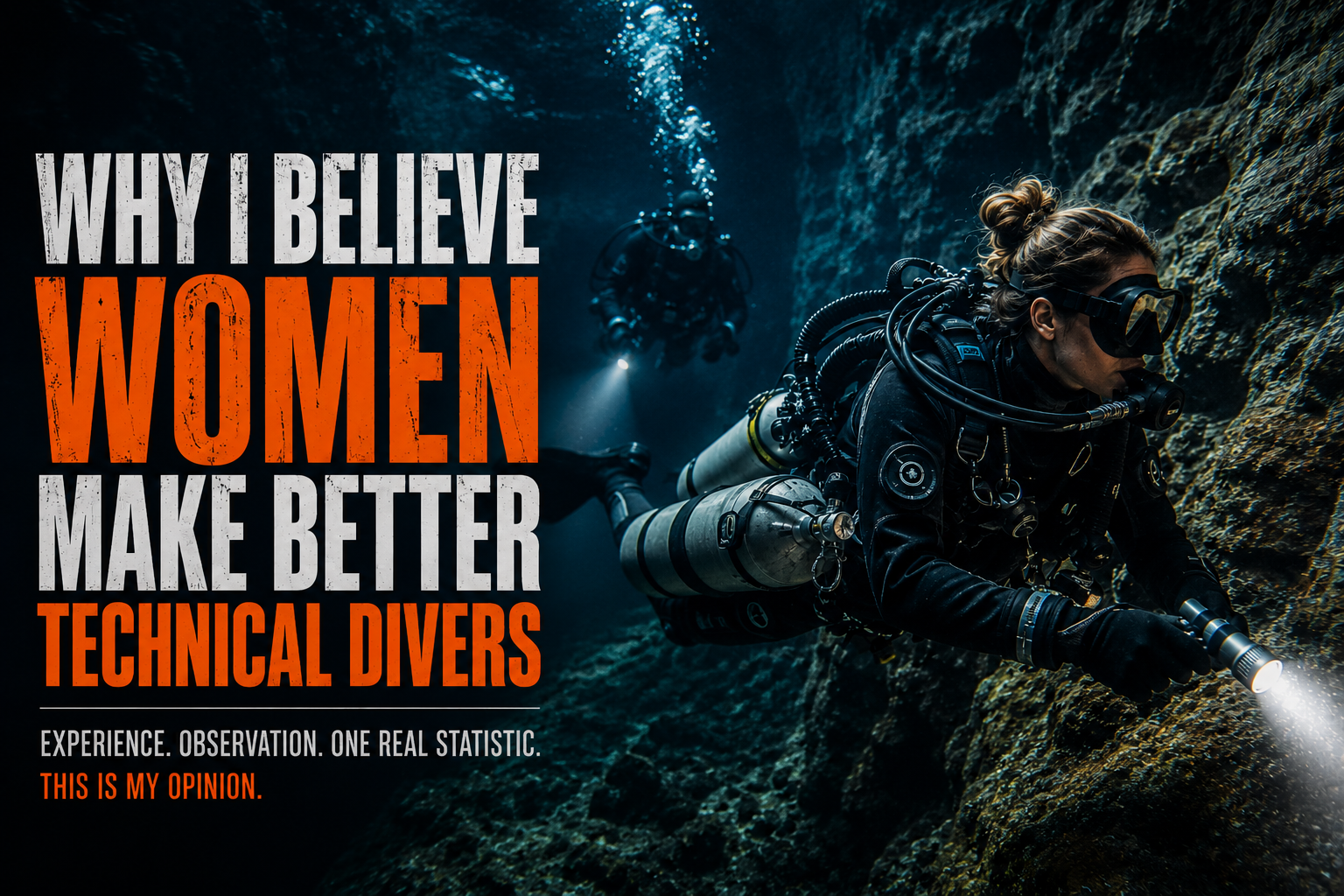
Why I Believe Women Make Better Technical Divers
I'm going to say something that will probably piss some people off.
I believe women make better technical divers.
That's my opinion. I'm not going to pretend it's a scientific conclusion, because it isn't. There isn't a stack of peer-reviewed research proving that women are better technical divers than men, and I'm certainly not qualified to make that claim.
What I do have is years in this industry, a lot of time underwater, and a lot of experience watching divers deal with problems when things don't go according to plan.
And after you've watched enough people underwater, you start noticing patterns.
The women I've trained with and dived alongside have consistently impressed me with the way they handle pressure. They tend to stay calm, communicate well, recognize problems early, and work through them without turning a manageable situation into a serious one.
That's what has led me to this opinion.
The One Data Point Worth Talking About
There is at least one piece of data that I think belongs in this conversation.
DAN Southern Africa has reported that, among DAN members, men were 2.8 times more likely than women to die while diving.
That's a significant difference.
But it doesn't tell us why.
DAN has been careful about that distinction. It might be tempting to look at the statistic and say, "Well, men must take more risks." Maybe they do. But a fatality rate by itself can't tell us that. There are a lot of other variables that could be involved, including the types of diving being done, experience levels, medical screening, exposure, risk tolerance, and probably things we haven't even considered.
So I'm not going to use that number as proof that women are better divers. It isn't proof.
But I also don't think a difference that large should simply be dismissed. At the very least, it raises an interesting question. And when you combine an interesting statistic with something you've been observing firsthand for years, it's hard not to pay attention.
What I've Actually Watched
Technical diving has a funny way of exposing people.
When everything is going well, it's relatively easy to look like a good diver. Your trim is good, your equipment is where it belongs, you're holding your position and you can perform the skills you've been taught. From the outside, you look completely in control.
The real test starts when something changes.
Maybe a piece of equipment isn't behaving the way you expected. Maybe your teammate needs help. Maybe visibility deteriorates. Maybe something starts leaking. Maybe you're deeper than you'd like to be when a problem develops.
That's when I start paying less attention to how polished someone looks and more attention to how they think.
Technical diving punishes ego. It doesn't care how many certifications you have, how deep you've been or how much expensive equipment you're carrying. When something goes wrong, what matters is whether you can recognize the problem, communicate with your team and deal with it without making things worse.
That's where I've noticed the difference.
In my experience, the women I've trained and trained with tend to become more focused when things get complicated rather than more frantic. They notice what's happening, deal with the immediate problem and somehow continue keeping track of what's happening around them.
That ability is incredibly valuable in technical diving.
It's also something that doesn't necessarily show up during a skills demonstration.
Marine
The clearest example I can give you is Marine.
I took a RAID Deco 50 course in the UAE with her. That course has since changed names and is now called the RAID Advanced Decompression course.
There wasn't one big dramatic emergency during that course that made me think, "That's when I knew Marine was an exceptional diver."
Actually, it was the opposite.
What stuck with me were the small things.
Something needed attention, and she dealt with it. A teammate needed managing, and she was already paying attention. Something wasn't quite right, and she noticed it.
What impressed me wasn't simply that she dealt with those things. It was the way she did it.
There was no obvious spike in stress. No frantic movement. No sudden change in demeanor. She didn't seem to lose awareness of everything else happening around her just because she had something to deal with.
She just worked through it. That may sound like a small thing, but it's not.
There's a huge difference between performing a perfect valve drill in a swimming pool while an instructor is watching you and dealing with a real problem while simultaneously keeping track of your position, your equipment, your gas and the people around you.
One is a demonstration of a skill, the other is diving.
Marine had the second one and I've never forgotten it.
And She's Not the Only One
Marine is the example that stands out most clearly because I was there and watched it happen, but she's not the only woman who has made me think this way.
I've had similar experiences with women like Mandy and Camilla in different places and different parts of the diving industry. They are different divers, with different backgrounds and different experiences, so I'm not suggesting there is some universal personality type that comes with being female.
What I am saying is that I've seen the same general behavior often enough that I don't think it's simply coincidence.
When things become complicated, they tend to get calmer rather than more frantic.
That's something I value enormously in a dive team.
When I'm diving with someone, I don't particularly care how many certifications they have. I don't care how deep they've been or whether they've got the latest computer and a thousand-dollar harness system.
I want to know what they're going to do when something doesn't go according to plan.
Are they going to recognize the problem and tell the team? Are they going to keep thinking? Or are they going to start rushing around trying to prove they've got everything under control?
I've seen all of those behaviors underwater.
And I've learned which ones I want beside me.
Maybe We're Rewarding the Wrong Things
I think some of this comes down to what technical diving has traditionally rewarded.
Confidence gets rewarded. Physical capability gets rewarded. Going deeper gets rewarded. Pushing further gets rewarded. In some corners of technical diving, being the guy who can handle anything gets you a lot of respect.
The problem is that none of those things necessarily make you a good teammate.
Technical diving isn't supposed to be a competition to see who can push the furthest before something finally goes wrong. A good technical diver should be able to recognize where the edge is and have enough discipline not to cross it simply because they can.
The same thing applies to problems.
The impressive diver isn't necessarily the one who can deal with the biggest emergency. I'd much rather dive with the person who notices the small problem early enough that it never becomes an emergency in the first place.
And that has nothing to do with physical strength.
It has to do with awareness, judgment, communication and the ability to stay useful when the situation becomes complicated.
Those qualities aren't particularly glamorous. They don't make especially exciting Instagram content. Nobody gets a thousand likes because they quietly noticed that their teammate's equipment wasn't sitting quite right and dealt with it before it became a problem.
But underwater, those are exactly the qualities I want around me.
And, based on what I've seen, women seem to bring them to technical diving more consistently.
I'm Not Saying Every Woman Is Better Than Every Man
Obviously, I'm not.
I've trained with some exceptional male divers and instructors. There are men in this industry who are incredibly good at managing themselves, managing a team and solving problems underwater. There are men I would trust with my life without giving it a second thought.
I've also met women who are terrible divers.
Being a woman doesn't automatically give someone better gas management, better trim or better judgment. Biology doesn't replace training, experience or good decision-making.
People are still people.
What I'm talking about is a pattern I've noticed over a lot of time in the water.
If you gave me a group of divers I'd never met and told me I had to bet on which person was most likely to remain calm, recognize a developing problem, communicate clearly and methodically work through it when the dive started going bad, my experience has taught me that I'd be very comfortable putting my money on the woman.
Maybe I'm wrong.
Maybe there's confirmation bias involved. Maybe the women I've happened to train and dive with aren't representative of women in diving generally. Maybe there are factors behind the DAN numbers that explain the difference and have nothing to do with the things I've been observing.
All of that is possible.
But it's still what I've seen.
And after enough time underwater, I've learned not to completely ignore a pattern simply because I can't prove it scientifically.
Take It for What It Is
This isn't a scientific paper, and I'm not pretending it is.
The DAN statistic is interesting, but it doesn't prove my argument. It raises a question.
My experience is what gave me an opinion.
That's it.
But I think it's an opinion worth discussing because the diving industry spends an enormous amount of time talking about equipment, certifications, agencies, standards, depth limits and technical procedures.
Those things matter.
But eventually, all of that equipment is hanging off a person.
And that person is the one who has to make the decision when something goes wrong.
That's the part I'm interested in.
Not who looks the best when everything is perfect.
Who remains useful when it isn't.
After years of watching divers deal with pressure underwater, I've developed a pretty strong opinion about who tends to handle it best.
I think women make better technical divers.
That's what I've seen.
Maybe you've seen something completely different.
If you have, I'd genuinely like to hear about it. I'm not interested in people agreeing with me just because the headline sounds good. If your experience has been the opposite, tell me why.
Because this is exactly the kind of conversation I think the diving industry could use more of.